

National Antivisection Society
NAVS calls on Government to stop secret suffering of animals in UK labs
Posted: 16 July 2013. Updated: 16 July 2013
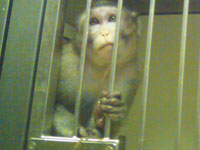
NAVS calls on the Government to stop the secret suffering of animals
in UK laboratories as latest figures on animal experiments released
The NAVS is calling on the Government to fulfil its commitment to reduce the number of animals used for research following the publication of the 2012 `Statistics of Scientific Procedures on Living Animals´ by the Home Office today.
The organisation is seeking the removal of the secrecy clause, Section 24 of the Animals (Scientific Procedures) Act 1986 Amendment Regulations 2012, which currently prevents wider public scientific scrutiny of animal tests.
UK legislation governing the use of animals in research has been updated to bring it into line with the European Directive on the use of animals in scientific procedures, which requires transparency and public accountability. The Government is consulting now.
The Government has a commitment to reduce and replace the number of animals that are used in experiments. Despite this, a total of 4.11 million procedures on animals were carried out in 2012, an increase of 317,171 (8.36 %) on 2011. The last time there were over 4 million experiments or procedures was 1982.
A summary of `Statistics of Scientific Procedures on Living Animals´ is as follows:
1. Just over 4.11 million scientific procedures were started in Great Britain in 2012, increasing 8.36%. Breeding of genetically modified (GM) animals and harmful mutants (HM), mainly mice, increased, accounting for 2.43 million procedures.
2. There were increases in numbers of procedures for several species, for example primates increased by 49.8%, from 1,459 in 2011 to 2,186 in 2012. The number of dogs used also increased from 2,865 to 3,214 animals - a rise of over 12%.
3. There was an increase in the number of animals used to 4,033,310 (+8.69%).
GM animals are becoming the `tool´ of choice in medical research, despite fundamental biological difference between them and humans. In order to create relatively small numbers of GM animals, large numbers of donor and recipient animals are used. Disturbingly, the creation of “surplus” animals is considered “an intrinsic and unavoidable characteristic of the technology". One paper described how GM mice suffered deformed limbs and fused bones, and scientists have stated that “Many failures and unexpected effects of genetic modification go unrecorded in the scientific literature so those that are recorded probably represent the tip of the iceberg".
Take action
- Please help the NAVS stop the secrecy - find out more here


