

National Antivisection Society
Brexit concerns for lab animals
Posted: 12 July 2017. Updated: 13 July 2017
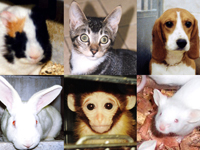
Concerns that hard fought for regulations on animal experiments could be lost after Brexit have been raised by the National Anti-Vivisection Society (NAVS), following the release of Home Office figures showing that 3,867,528 animals were used for research last year, a decrease of 201,821. The NAVS is seeking a clear commitment from government that measures will not be dismantled.
There are particular concerns that Brexit could harm the development of alternative methods and lead to an increase in duplication of animal experiments if not addressed. Also that some areas covered by EU but not UK law could be dropped: controls on inspections, detailed recording on cat, dog and primate use, and a commitment to phase out the use of macaques from wild caught parents. Although the UK statistics suggest no current use of monkeys born to wild caught parents, it does import from countries such as Mauritius where monkey breeders restock with animals captured in the wild.
While the UK is unlikely to allow cosmetics testing on animals once again, the EU Cosmetics Directive also bans the import of products that have been tested on animals. This key Directive prevents manufacturers in the USA, China and others from selling their products in Europe if they have been animal tested.
The latest Home Office figures on the use of animals in research reveal:
- Over 784,824 experiments and breeding procedures forced animals to suffer severely (153,558) or moderately (631,266 - an increase of 64,208). `Severe´ suffering can include internal bleeding, heart failure, and nerve damage. `Moderate´ suffering can include implanting a device into monkeys´ skulls, with common adverse effects including wound infections. 1,484,320 ‘mild’ experiments were conducted, a decrease of 385,199. `Mild´ suffering can include food or water restriction to motivate performance in behavioural tasks and foot shocks in mice.
- 2,863,717 mice, the most commonly used species, were used in tests, a decrease of 171,132 and 245,583 rats, a decrease of 20,155.
- 535,069 fish, the second most used species, were used in experiments, a decrease of 17,193.
- 3,530 dogs were used in tests, an increase of 125. Experiments can involve force-feeding compounds such as agricultural chemicals, or having toxic substances pumped into their veins.
- 2,440 monkeys were used in experiments, an increase of 206. Monkeys are used mainly to test drugs and typically endure force-feeding or injections of experimental compounds; full body immobilisation in restraint chairs whilst they are experimented on.
- 729,390 experiments were on genetically modified animals. A further 1,914,040 procedures were for the creation and maintenance of animals with genetic modifications, who can suffer from deformed limbs, fused bones and painful swellings. Of the total 2,643,430 procedures involved in the genetic alteration of animals, 2,226,516 included mice and 395,981 fish.
Secrecy is also an issue. The wider public and scientific scrutiny of Home Office decisions is prevented by Section 24 of the Animals (Scientific Procedures) Act 1986 (2012 Amended) (ASPA) which places a blanket ban on the release of details about animal experiments. Proposals to reform Section 24 (the `secrecy clause´) were announced over three years ago, and the public consulted on the issue, but action has yet to be taken, or the results of the consultation published. The delay, the NAVS understands, is due to an overhaul of the Freedom of Information Act which will have an effect on the functioning of Section 24. In response to a parliamentary question last week on the consultation, Minister of State Ben Wallace said “I intend to publish the response in due course."
Take action for lab animals!
- Write to your MP, urging them to protect lab animals.
- Help spread the word by sharing our action call on Facebook and Twitter!
- Support our work to stop lab animal suffering.


