

National Antivisection Society
Animal experiments: background stories
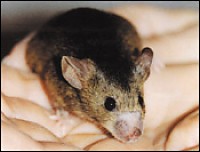
Genetic Modification
There is a worldwide explosion in new technologies relating to the manipulation of genes. Huge media interest is being generated in any bizarre development, regardless of how vague or remote, the potential human application. However, share prices of genetic modification companies can soar on the back of extravagant claims.
For animals being created by genetic modification or being cloned it is just another ever expanding area of suffering.
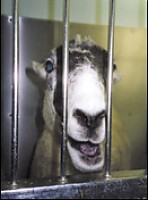
R.I.P. Dolly 5.7.96-14.2.03
Born on 5th July 1996 Dolly the sheep, the first mammal to be cloned from an adult cell, was put to sleep at the tender age of six and a half on the 14th February this year on the instructions of Ian Wilmut, the man most directly responsible for her existence(1,2). In her short life she symbolised the hopes and hype of cloning, and her death is seen by many as evidence that the practice is not only unprincipled but unworkable.
Dolly’s autopsy revealed that she was suffering from a virus that caused a tumour in her lung(3). Although it is not unusual for sheep to suffer lung infections, it is generally amongst older animals(1). Sheep can live to the age of 21, so Dolly was not old. Last year it was announced that Dolly had arthritis(4), again a complaint of older animals. Prior analysis of cells taken from Dolly appeared to show that she was ‘older’ than her chronological age(5). Meanwhile subsequently published research in Japan found that on average cloned mice had shorter lives than normal ones(6). If a clone is subject to reduced lifespan then it will impact on all uses for these animals, including using cloned animals as organ donors - surgeons would simply be putting an ageing organ into a patient(5).
Dolly’s suffering can only be wondered at (Wilmut said that had he been a hill farmer he would not have let things go on this long(1)). But suffering and waste of life emerges throughout cloning. Only around 3% of cell nuclei transferred to donor eggs result in live births(3), let alone animals which live to old age. Wilmut himself has said that since Dolly’s birth there have been huge numbers of miscarriages and deformities during cloning experiments, few cloned animals have survived until birth, and those that have, are often abnormally large or have other defects of the kind one commentator has called a ‘gallery of horrors’ (7,8).
Yet the suffering and lack of practical benefit seem of little consequence. Not only can huge surges in share prices arise on the back of speculation about it but even national pride itself can be buttressed with it - Dolly will be stuffed and put on display at the Museum of Scotland in Edinburgh(3).
(1) Meek, J. Guardian Unlimited.
http://www.guardian.co.uk/uk_news/story/0,3604,895944,00.html
(2) Knight, W. NewScientist.com.
http://www.newscientist.com/hottopics/cloning
(3)Nature 2003 February 20; 421: 776
(4) Naik, G. Wall Street Journal [Europe] 2002 January 7; 9
(5) Hawkes, N. The Times 2002 January 5; 22
(6) Scrip 2002 February 15; 2721: 23
(7) Campaigner 2001 May-August; 35
(8) New Scientist 2001 December 15; 14


