

National Antivisection Society
Rise in animal experiments in Ireland
Posted: 5 January 2015. Updated: 5 January 2015
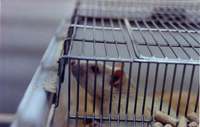
Statistics on the use of animals in experiments in the Republic of Ireland have recently been published by the Health Products Regulatory Authority and show that a total of 277,559 animals were used for the first time in 2013 and that there were a total of "279,379 uses of animals for procedures" but, astonishingly, the statistics do not indicate how many animals were actually used.
This is the first year that the HPRA has been responsible for the statistics, with responsibility for the duty being transferred from the Department of Health. The HPRA state that any comparison between these and previous figures "would not be meaningful or accurate". The statistics are also the first to be published under the new regime introduced by European Directive 2010/63.
The most used species was mice, accounting for more than 92% of animals used for the first time, with experiments also being conducted on other rodent species, farm animals, birds, frogs, fish and cats. A total of 696 procedures were conducted on dogs; all of these animals had previously been used in research.
Unlike the UK, which is seeing a large increase in the use of genetically altered animals, in this report these animals accounted for 4% of animal use.
Researchers are now required to record the `actual severity´ of experiments, assessed when the work is concluded. “Overall 70% of animals were involved in procedures that were classified as `severe´” and, while no details of the procedures are given, 99.6% of these animals were mice. Rats, rabbits, cattle and one frog were also subjected to severe experiments.
An example of a project which has been classified as `severe´ involves giving pregnant and lactating rats the drug methamphetamine and then forcing their offspring to swim in a cylinder filled with water from which they could not escape among other tests. The project summary estimates it would use 1,500 rats over a 36 month period and states one of the aims as being to learn about the possible effects of methamphetamine on unborn children.
The HPRA has pledged that it will "continue to apply its influence and judgement...to ensure that studies are only permitted where there is no alternative...and the expected benefits outweigh any possible adverse effects." Only time will tell if this pledge will lead to a reduction in the number of animals used in Ireland.


