

National Antivisection Society
Efforts to save the AstraZeneca beagles
Posted: 22 January 2013. Updated: 13 March 2013
Latest news:
- The beagles have sadly now been sent to the AstraZeneca research facility at Alderley Park in Cheshire. Thank you to everyone who contacted AstraZeneca, and the UK and Swedish Prime Ministers, to request for these beagles to be rehomed.
- 01.03.13 - NAVS calls on AstraZeneca to free the beagles as hundreds are detained at Manchester airport Read more
- 27.02.13 Beagles destined for the lab arrive in the UK as AstraZeneca ignores pleas to save them Read more
- 18.02.13 - AstraZeneca urged not to send beagles to the lab - Read more
- 13.02.13 - According to our friends at Djurrättsalliansen, a total of 50 dogs have been taken from the facility to Mölndal. They were transported on 26 January and 8 February.
- 30 dogs have already been flown from Angelholm/Helsingborg airport to Manchester airport on 7th January via Aeronova.
- Groups united to save beagles tell AstraZeneca “the world is watching"
Hundreds of beagles destined for the lab
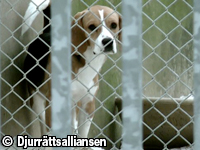
NAVS is supporting calls being made by our Swedish friends at Djurrättsalliansen (Animal Rights Alliance) that hundreds of beagles currently housed at AstraZeneca kennels in Sweden, earmarked for closure, be rehomed, instead of being sent to facilities to be used as research tools.The beagles near Örkelljungain are currently destined to be sent to the UK, to AstraZeneca labs in Cheshire, and we have been informed Huntingdon Life Sciences (HLS), where they will be subjected to cruel and painful tests.
According to The Times, the closure is part of a £1 billion cost-cutting drive involving 7,300 job cuts and the company buying in, rather than breeding, dogs. In addition to the Swedish facility, AstraZeneca is also closing kennels in the UK.
The beagles CAN be successfully rehomed, despite AstraZeneca claims
Although AstraZeneca has permitted employees to rehome as many as 80 of the beagles, it is refusing to allow members of the public to adopt the dogs, arguing that they make unsuitable companions.There is no absolutely no reason why these animals cannot be successfully rehomed by the public. As stated in the LASA Guidance on the Rehoming of Laboratory Dogs "Some establishments have successfully rehomed laboratory dogs over many years" and the NAVS has personal experience of rehoming laboratory animals, including the rescue of six beagles from Interfauna who, at the time, were one of Europe´s largest suppliers sending 2,800 beagle puppies to their deaths in laboratories all over Europe, the Middle East and the Far East.
AstraZeneca commission unnecessary animal research - NAVS investigates
An AstraZeneca spokeswoman has said: "The team has concluded that, because these dogs have been purpose-bred for research and they are needed to support our global research efforts, the best solution is to continue to utilise them for research at AstraZeneca facilities and by third parties acting on our behalf."We can only imagine the needless suffering that awaits these animals. An NAVS report into the contract testing laboratory Inveresk, based in Scotland, exposed how AstraZeneca commissioned unnecessary and painful animal research.
In a test categorised with a `moderate´ severity limit, a small tube was inserted into the leg vein of 16 macaque monkeys, where it remained so that they could be dosed with an experimental asthma drug. Each day for 14 days the animals received an intravenous injection; this was despite the fact that the drug should be inhaled by humans. Animals were deprived of food and water to obtain samples and suffered a range of symptoms following dosing of the drug which included: reddening of the face and lips, diarrhoea, swelling in the stomach, redness of feet and hands, red and swollen penises and scrota, body tremors, abdominal and umbilical hernias in females and all animals suffered weight and appetite loss. The animals were then killed.
The report of this study admits that Astra Zeneca was in possession of information from previous experiments in the same species. In addition to the fact that the drug was intended for inhalation in humans, and the monkeys received the drug through the vein, it was also already known that a similar asthma drug developed by AstraZeneca gave different results after administration by intravenous infusion compared with administration by inhalation.
Beagles bound for Swedish lab tracked
Just months before rescuing beagles from Interfauna, NAVS tracked two flights of beagles from the UK to Sweden, where they were destined for the lab at Astra AB. Prone to travel sickness, the journey in an unpressurised aircraft would have been a frightening and bewildering experience for the beagles.HLS exposed
HLS is contracted by pharmaceutical, chemical, industrial and other companies to perform toxicology (safety testing) and other tests on their products, one of the most secretive areas of animal experimentation. As part of our campaign to end primate experiments across Europe, NAVS spent over a year inside the primate toxicology unit of HLS in Cambridgeshire, possibly which has a capacity of around 500 macaque monkeys and up to 2,500 dogs.We saw tests using between 4 and 72 monkeys; all involved physical restraint of the monkeys, sometimes being strapped into chairs, causing great distress. For some the stress was too much - they suffered rectal prolapse, a known indicator of stress in restrained primates. During an oral dosing study, some monkeys vomited and salivated on many occasions. One almost chewed off its whole finger, continuing to chew its hand after the vet had dressed it. On an inhalation study, three monkeys died or were killed due to partially collapsed and blocked lungs. At the post mortem their lungs were found to be blackened; they would have suffered greatly.


